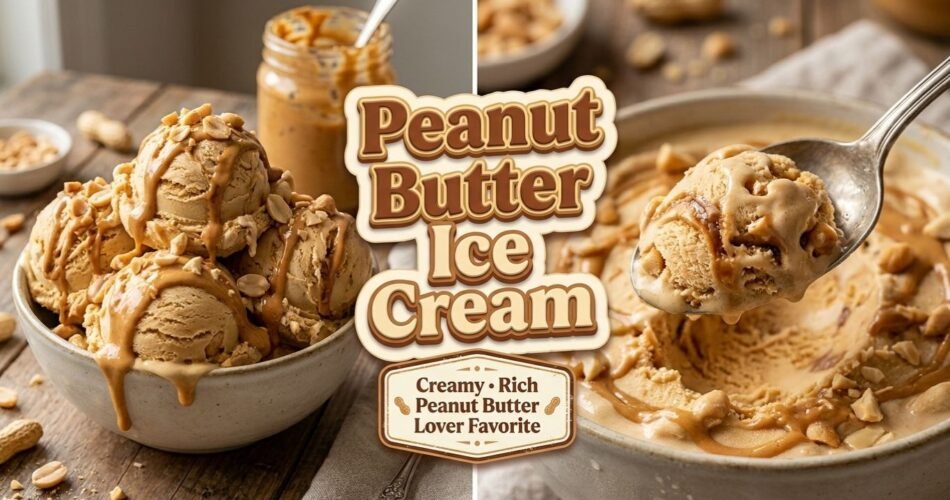
Let me be completely honest with you: I didn’t think homemade peanut butter ice cream could beat the store-bought stuff. I was wrong. Very, very wrong.
The first time I made this, I pulled the container out of the freezer after six hours and dug in with a spoon before it even hit a bowl. It was that good — intensely nutty, impossibly creamy, with that deep, roasted peanut flavor that hits you right at the back of your throat.
This recipe works for two types of people. If you own an ice cream machine, there’s a churned version that gives you a scoopable, perfectly airy texture. If you don’t? The no-churn method produces something dangerously close to soft-serve fudge. Both are outstanding.
This is the recipe for weekends when you want to impress without stressing, for peanut butter lovers who deserve better than a pint of mediocre store-bought, and for anyone who’s ever stood in front of the ice cream aisle wishing something tasted more.
Why This Peanut Butter Ice Cream Recipe Actually Works
It’s Built on Real Culinary Logic — Not Just Luck
There are a thousand peanut butter ice cream recipes out there. Most of them are fine. This one is better, and here’s why.
1. Full-fat everything — no shortcuts.
Heavy cream and whole milk (or full-fat coconut milk for dairy-free) are non-negotiable. Fat is what creates that smooth, melt-on-your-tongue texture. Lower-fat alternatives make icy, grainy ice cream. Don’t do it to yourself.
2. We use a warm peanut butter base.
Gently heating the peanut butter with the cream before churning or freezing does something magical — it blooms the nutty flavor and makes it distribute evenly throughout every single bite. Cold peanut butter clumps. Warm peanut butter integrates.
3. The egg yolk situation.
For the churned version, egg yolks are the secret weapon. They add richness, act as an emulsifier, and are the reason restaurant ice cream always tastes more luxurious than the grocery store version. They’re doing a lot of heavy lifting here.
4. Salt is not optional.
A pinch of fine sea salt in the base, and flaky salt on top when you serve it, makes the peanut butter flavor pop in a way that’s almost shocking. Salt suppresses bitterness and amplifies sweetness. Skip it and the whole thing tastes flat.
5. Freezing time matters more than you think.
I used to rush it. Six hours minimum, overnight is better. Ice cream needs time for the ice crystals to fully form and stabilize. Pull it too early and you get soft, soupy soup. Be patient. It’s worth it.
Key Ingredients & Smart Substitutions
Here’s what you need and why each thing earns its spot in the bowl.
- Creamy peanut butter (1 cup / 250g): Use a conventional brand like Jif or Skippy — not natural peanut butter. Natural peanut butter separates and makes the texture grainy and oily. Trust me on this one.
- Heavy whipping cream (2 cups / 480ml): The backbone of your ice cream. This is what you’re whipping into soft peaks for the no-churn version. Sub: Full-fat coconut cream for a dairy-free version — it works beautifully.
- Whole milk (1 cup / 240ml): Keeps the base from being too dense. Sub: Oat milk works in a pinch but expect a slightly icier texture.
- Granulated sugar (¾ cup / 150g): Standard sweetener. Sub: Coconut sugar adds a subtle caramel note if you’re into that.
- Egg yolks (4 large): For the churned version only — creates a custard base that’s rich and ultra-smooth.
- Vanilla extract (1 tsp): Rounds out the peanut butter and gives it depth. Use real vanilla. The imitation stuff is fine in a pinch, but real vanilla is noticeably better here.
- Fine sea salt (½ tsp): See above. Not optional.
- Sweetened condensed milk (1 can / 14 oz / 396g): For the no-churn version only — this replaces the custard base and gives incredible sweetness and body.
Step-by-Step Instructions
No-Churn Peanut Butter Ice Cream (The Easy Route)
Step 1: Make your peanut butter base.
In a small saucepan over low heat, warm the peanut butter with 2 tablespoons of heavy cream, stirring constantly, for about 2 minutes until it’s completely smooth and slightly loosened. Remove from heat and stir in the vanilla and salt. Let it cool for 10 minutes.
📝 Chef’s Note: Don’t skip the cooling step. Adding hot peanut butter directly to whipped cream will deflate all those beautiful air bubbles you’re about to create.
Step 2: Whip the cream.
Pour the remaining cold heavy cream into a large, chilled bowl. Whip with a hand mixer or stand mixer on medium-high speed until stiff peaks form — about 3-4 minutes. The cream should hold its shape when you lift the beater.
📝 Chef’s Note: Cold cream whips faster and holds its structure better. Pop your bowl and beaters in the freezer for 10 minutes before you start if your kitchen is warm.
Step 3: Fold everything together.
Pour the sweetened condensed milk into the peanut butter mixture and stir until fully combined. Now, gently fold this mixture into the whipped cream using a rubber spatula. Use slow, sweeping motions from the bottom up. You want to keep as much air in there as possible — that’s what makes it creamy, not icy.
Step 4: Freeze it.
Pour into a loaf pan or freezer-safe container. Smooth the top, then press plastic wrap directly against the surface to prevent ice crystals from forming. Cover with a lid or foil and freeze for a minimum of 6 hours, overnight preferred.
Churned Peanut Butter Ice Cream (The Ice Cream Machine Version)
Step 1: Make the custard base.
In a medium saucepan, warm the milk and 1 cup of heavy cream over medium heat until you see small bubbles forming at the edges — don’t let it boil. Meanwhile, whisk the egg yolks and sugar together in a bowl until the mixture turns pale yellow and slightly thick, about 2 minutes.
Step 2: Temper the eggs.
This is where most people mess up. Slowly pour a ladle of the hot cream mixture into the egg yolks while whisking constantly. This raises the temperature of the eggs gradually so they don’t scramble. Add another ladle. Then pour the whole egg mixture back into the saucepan.
📝 Chef’s Note: If you see any cooked egg bits forming, you moved too fast. Just strain the custard through a fine-mesh sieve — problem solved.
Step 3: Cook the custard.
Stir constantly over medium-low heat until the mixture thickens enough to coat the back of a spoon, about 8-10 minutes. Run your finger through the coating on the spoon — if the line holds clean, you’re done. Remove from heat.
Step 4: Add the peanut butter.
Whisk in the warm peanut butter, remaining cream, vanilla, and salt until everything is completely smooth. Pour through a fine-mesh sieve into a clean bowl. Press plastic wrap against the surface and refrigerate until completely cold, at least 4 hours (overnight is best).
Troubleshooting & FAQs
My ice cream came out icy, not creamy. What happened?
This almost always comes down to one of two things: not enough fat in the base, or pulling it out of the freezer too early. Make sure you’re using full-fat cream and giving it the full 6-hour freeze. For the no-churn version, double-check that your whipped cream was at stiff peaks before folding.
Can I use natural peanut butter?
Technically yes, but it’s genuinely not recommended. Natural peanut butter’s oil separation can create an uneven, slightly gritty texture in the final product. If that’s all you have, stir it extremely well and make sure it’s at room temperature before using.
Can I add mix-ins like chocolate chips or Reese’s?
Absolutely — and please do. For the no-churn version, fold in ½ cup of mini chocolate chips or chopped peanut butter cups right before pouring into the pan. For the churned version, add them in the last 2 minutes of churning.
Why does my no-churn version taste a little sweeter than I expected?
Sweetened condensed milk is very sweet — that’s just the nature of the no-churn method. If you prefer less sweetness, you can reduce the condensed milk to ¾ of the can and add a tablespoon of cream cheese for body. It softens the sweetness noticeably.
Storage, Make-Ahead & Serving Tips
In the freezer: Stored properly in an airtight container with plastic wrap pressed against the surface, this peanut butter ice cream keeps beautifully for up to 3 weeks. After that, ice crystals start to take over and the texture suffers.
Scooping tip: Let the container sit at room temperature for 5 minutes before scooping. This is especially important for the churned version, which gets quite firm. A warm scoop (run under hot water and dried) also helps.
Make-ahead: This is a fantastic make-ahead dessert. The no-churn version can go straight from mixing to the freezer up to 3 days before you need it. The churned custard base can be made and refrigerated 2 days before churning.
Serving ideas: Drizzle with hot fudge, sprinkle with flaky sea salt and crushed Reese’s Pieces, sandwich between two chocolate cookies, or go full sundae with banana slices and caramel sauce.
Check — Mixed Berry Ice Cream Recipe
Check — Perfect Panna Cotta Recipe
Check — Homemade Peppermint Ice Cream
Check — Mango Bars with Lime Glaze