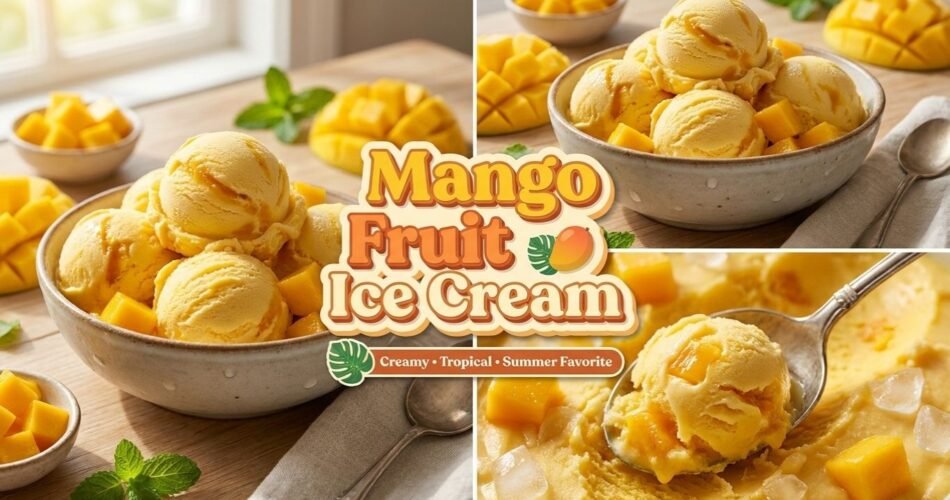
The first time I made mango fruit ice cream at home, I used fresh mangoes that were slightly underripe. The result? An icy, pale, vaguely mango-flavored disappointment that nobody at the table was excited about.
I almost gave up on the idea entirely.
Then a friend who grew up in South India told me the secret: the mango does the heavy lifting, so it has to be perfect. She was right. Once I switched to deeply ripe Alphonso mangoes (or an equally ripe Ataulfo), everything changed. That ice cream was silky, vivid orange, and tasted like biting into a cold mango on a beach somewhere hot.
This recipe is for anyone who’s ever bought a pint of mango ice cream at the grocery store and thought, “this is fine, but it doesn’t taste like real fruit.” It’s also for people who don’t own an ice cream machine — because you genuinely don’t need one here.
Four ingredients. No churning. Pure mango flavor. Let’s get into it.
Why This Mango Fruit Ice Cream Recipe Actually Works
There are hundreds of mango ice cream recipes floating around. Here’s why this one is different — and better.
1. It Starts With Overripe Mango (On Purpose)
Most recipes just say “use ripe mango.” That’s not specific enough. You want almost-too-ripe mangoes — the ones that are soft to the press and smell intensely fruity near the stem. The natural sugar concentration in an overripe mango is significantly higher, which means two things: deeper flavor and a creamier freeze. Fruit with higher sugar content doesn’t freeze as hard or icy. That’s just food science working in your favor.
2. We Whip the Cream Separately — Here’s Why
Folding whipped cream into the condensed milk base (rather than blending everything together) traps millions of tiny air bubbles throughout the mixture. Those air bubbles are what give no-churn ice cream its scoopable, creamy texture instead of a frozen brick. Don’t skip this step or rush it.
3. A Pinch of Salt Changes Everything
Salt in a sweet recipe sounds counterintuitive. But salt suppresses bitterness and amplifies sweetness at the same time. A small pinch in this recipe makes the mango flavor pop in a way that sugar alone never could. You won’t taste the salt — you’ll just notice the ice cream tastes more mango-y.
4. Lime Zest Adds Dimension, Not Just Flavor
Fresh lime zest (not juice — zest) introduces a bright, floral top note that balances the rich sweetness of the condensed milk. It’s the difference between a mango ice cream that tastes one-dimensional and one that tastes genuinely complex. One lime does the job perfectly.
5. The Freeze Time Is Non-Negotiable
I know the urge to check on it at the 4-hour mark. Resist it. Full 6–8 hours — ideally overnight — is what gives this ice cream the proper texture throughout. A partially frozen batch scoops grainy and uneven. Patience here is an actual technique.
Key Ingredients & Smart Substitutions
Ripe Mangoes (3 large) — The star. Alphonso, Ataulfo, or Kesar mangoes are the gold standard. Frozen mango chunks (thawed and drained) work well when fresh aren’t available. Avoid fibrous Tommy Atkins mangoes for this recipe — they’re stringy and less sweet.
Heavy Whipping Cream (2 cups / 480ml) — You need the fat content (at least 36%) to get proper whipped volume. Don’t substitute half-and-half or light cream; it won’t whip stiff enough. Dairy-free option: Full-fat canned coconut cream, refrigerated overnight, works beautifully here.
Sweetened Condensed Milk (¾ cup / 200g) — Acts as both sweetener and base, and its high sugar content helps prevent ice crystals. Dairy-free option: Coconut condensed milk is now widely available and swaps in 1:1.
Lime Zest (from 1 lime) — Brightens the whole thing. You can use lemon zest in a pinch.
Fine Sea Salt (¼ tsp) — Just a pinch. Don’t skip it.
Optional add-ins: A teaspoon of pure vanilla extract, a tiny pinch of cardamom (classic Indian pairing), or swirls of mango coulis through the finished base.
Step-by-Step Instructions
Step 1: Prep Your Mangoes
Peel and dice your mangoes, then blend them in a food processor or blender until completely smooth. You’re looking for a thick, luscious purée — no chunks, no strings.
Chef’s Note: After blending, taste the purée. If it doesn’t make you close your eyes, your mangoes aren’t ripe enough. This is your one quality checkpoint, and it matters.
You should end up with roughly 1½ cups (360ml) of mango purée. Measure it — too much will make the base too heavy and it won’t freeze as smoothly.
Step 2: Combine the Base
In a large mixing bowl, stir together the mango purée, condensed milk, lime zest, and salt until fully combined. Give it a taste. It should be a touch sweeter than you want the finished ice cream to be — the cold dulls sweetness slightly.
Set this bowl aside.
Step 3: Whip the Cream
Using a hand mixer or stand mixer with the whisk attachment, whip the heavy cream on medium-high speed until stiff peaks form. This usually takes 3–4 minutes. The cream should hold its shape when you pull up the whisk.
Chef’s Note: Cold cream whips faster and more stably. If your kitchen is warm, chill your bowl and beaters in the freezer for 10 minutes first. This isn’t fussy — it’s just smart.
Step 4: Fold — Don’t Stir
Add roughly one-third of the whipped cream to the mango base and stir it in gently to lighten the mixture. Then add the remaining whipped cream in two additions, folding slowly with a rubber spatula using large, sweeping motions from the bottom of the bowl.
You want to see a consistent, peachy-orange color with no white streaks — but stop the moment you get there. Overmixing deflates those air bubbles we worked hard to create.
Step 5: Pour and Freeze
Pour the mixture into a freezer-safe container — a standard 9×5 inch loaf pan works perfectly. Press a piece of plastic wrap directly against the surface of the ice cream (this prevents ice crystals from forming on top). Cover with a lid or foil.
Freeze for a minimum of 6 hours. Overnight is better.
Chef’s Note: If your loaf pan is metal, it conducts cold faster and the ice cream will freeze more evenly than in a glass or ceramic dish.
Step 6: Scoop and Serve
Pull it from the freezer about 5 minutes before scooping. This lets it soften just enough to scoop cleanly without cracking.
Serve as-is, or top with fresh mango chunks, a squeeze of lime, toasted coconut flakes, or a pinch of Tajín if you like a sweet-salty-spicy kick.
Troubleshooting & FAQs
Q: My ice cream came out icy and grainy — what happened?
Almost always, this comes down to one of two things: mangoes that weren’t sweet enough (less sugar = more ice crystals), or cream that wasn’t whipped to stiff enough peaks. Check both next time. Also make sure your condensed milk is measured accurately — too little throws off the balance.
Q: Can I use frozen mango instead of fresh?
Yes — with one important step. Thaw it completely, then drain off as much liquid as possible before blending. Excess water is the enemy of creamy ice cream. Pat the chunks dry with paper towels if needed.
Q: It’s been 6 hours and it’s still soft in the middle. Is that normal?
It depends on your freezer. Some home freezers run warmer than the dial suggests. Give it another 2 hours. If it’s consistently soft after 8+ hours, your cream may not have been whipped stiff enough, or there was too much liquid in the mango purée.
Q: Can I make this without condensed milk?
Technically yes, but the texture will suffer. Condensed milk contributes both sweetness and a creaminess that’s hard to replicate. If you need a lower-sugar version, use about ½ cup condensed milk and add 2 tablespoons of powdered sugar to compensate slightly — though the texture will be slightly icier.
Storage, Freezing, and Make-Ahead Tips
In the freezer: This ice cream keeps well for up to 3 weeks. After that, ice crystals start to develop on the surface and the texture gets a bit rough.
The plastic wrap trick: Always press plastic wrap directly onto the surface of the ice cream before putting the lid on. It’s a small habit that dramatically reduces freezer burn and surface ice crystals.
Making ahead for a party: This is genuinely ideal for entertaining — make it 2–3 days in advance and don’t stress. Pull it out 5 minutes before serving and you’re golden.
Individual portions: Pour the mixture into popsicle molds before freezing for easy single-serve portions. Insert sticks after about 45 minutes when it’s partially set.
Check — Mixed Berry Ice Cream Recipe
Check — Key Lime Pie Ice Cream
Check — Homemade Peppermint Ice Cream