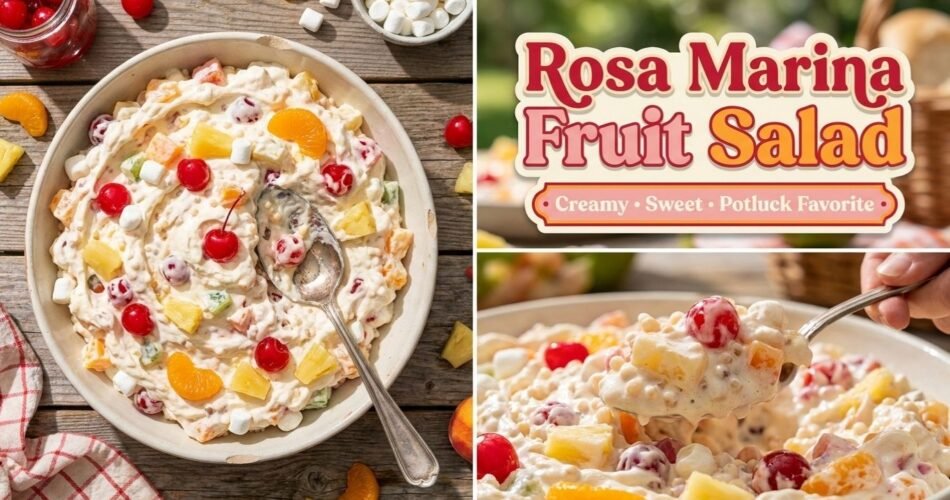
The first time someone handed me a bowl of Rosa Marina fruit salad at a church potluck, I genuinely didn’t know what I was eating. Tiny, rice-shaped pasta. Canned mandarin oranges. Whipped topping. Maraschino cherries.
I was skeptical. Then I took a bite.
Reader, I went back for thirds.
This Rosa Marina fruit salad — also called orzo fruit salad or frog eye salad’s lesser-known cousin — is one of those recipes that sounds completely bizarre until it’s in your mouth. The pasta gives it body, the fruit gives it brightness, and the creamy dressing ties everything together in a way that feels almost dessert-like. Almost.
It’s the perfect side dish for summer cookouts, potlucks, holiday gatherings, or honestly just a Tuesday when you want something that feels both indulgent and somehow refreshing. It chills overnight and actually gets better as it sits, which makes it a dream for anyone who loves a make-ahead dish.
This recipe is for you if you want something that feeds a crowd, requires zero fancy technique, and disappears from the table in about eight minutes flat.
Why This Rosa Marina Fruit Salad Actually Works
A lot of versions of this recipe out there are fine. Just fine. They’re too sweet, too watery, or the pasta gets gummy by the time you serve it. Here’s what separates a really good version from a mediocre one.
1. You have to cook the rosa marina pasta just right — and cool it completely.
Overcooked orzo or rosa marina pasta turns into a mushy, starchy mess once it’s dressed. You want it al dente with a tiny bit of bite. And here’s the non-negotiable part: the pasta must be completely, genuinely cold before you add any dairy-based ingredients. Warm pasta melts the whipped topping and you end up with soup. I learned this the hard way at my very first attempt — I thought “pretty cool” was good enough. It wasn’t.
2. Drain your fruit aggressively.
Canned fruit is swimming in syrup, and all that liquid will waterlog your salad. I lay my mandarin oranges and pineapple on a clean kitchen towel for a few minutes after draining. It feels fussy but the difference in texture is significant.
3. The ratio of whipped topping to cream cheese matters.
Too much whipped topping and the salad tastes like you’re eating a cloud — all air, no substance. A small amount of softened cream cheese stirred in first creates a creamy base with actual body. It also helps the dressing cling to the pasta instead of pooling at the bottom.
4. Overnight chilling isn’t optional — it’s the whole point.
The pasta absorbs a bit of the dressing as it sits, the flavors meld together, and everything becomes more cohesive. If you try to serve this fresh, it tastes disjointed. Give it at least four hours. Overnight is better.
5. A touch of vanilla and just a whisper of salt.
Salt in a sweet salad sounds counterintuitive, but a tiny pinch sharpens the fruit flavors and keeps it from tasting flat. Same logic as salting caramel. Trust it.
Key Ingredients & Smart Substitutions
Rosa Marina pasta (orzo) — This small, rice-shaped pasta is the foundation of the dish. If you can’t find it labeled “rosa marina,” orzo is the exact same thing and widely available.
Crushed pineapple (canned) — Adds tropical sweetness and moisture. Drain it well. You can substitute with fresh pineapple chopped very fine, but canned is honestly more consistent here.
Mandarin oranges (canned) — They’re tender, sweet, and hold their shape. Fresh mandarin segments work too, but remove any white pith or they’ll turn bitter overnight.
Maraschino cherries — Purely aesthetic and nostalgic, but they add a pop of color and a sweet finish. Leave them out if you’re not into them, or swap for fresh halved cherries.
Whipped topping (Cool Whip or similar) — The creamy backbone. For a dairy-free version, there are coconut cream-based whipped toppings that work beautifully. Don’t use regular heavy cream whipped at home — it deflates too fast.
Cream cheese — Just a small amount, fully softened. It stabilizes the dressing. Dairy-free cream cheese works as a substitute.
Powdered sugar — Dissolves instantly into the dressing without any graininess. Adjust to taste based on how sweet your fruit is.
Vanilla extract — A half teaspoon makes the whole thing taste more intentional. Don’t skip it.
Pinch of salt — See above. Trust the process.
Optional add-ins: Mini marshmallows (classic), shredded sweetened coconut, diced fresh strawberries, or even a handful of chopped pecans for texture.
Step-by-Step Instructions
Step 1: Cook and Cool the Pasta
Bring a large pot of water to a rolling boil. Salt it generously — it should taste like the sea.
Add 1½ cups of dry rosa marina pasta and cook according to package directions, but pull it about 30 seconds early. You want it al dente.
Drain, then rinse under cold water for a full minute to stop the cooking and rinse away excess starch. Spread it out on a baking sheet lined with parchment to cool completely. Pop it in the fridge for at least 30 minutes.
Chef’s Note: Don’t skip the rinse. Rosa marina releases a lot of starch, and rinsing keeps the salad from becoming gluey. Yes, I know, rinsing pasta is controversial — but this isn’t a hot pasta dish, so the rules are different here.
Step 2: Drain Your Fruit Thoroughly
Open your cans of crushed pineapple and mandarin oranges. Drain them through a fine mesh strainer, then tip them out onto a clean kitchen towel or a few layers of paper towels.
Gently pat them dry. Let them sit for 5 minutes while you make the dressing.
Step 3: Make the Creamy Dressing
In a large mixing bowl, beat 4 oz of softened cream cheese with a hand mixer (or a sturdy whisk and some muscle) until it’s completely smooth — no lumps.
Add 2 tablespoons of powdered sugar and ½ teaspoon of vanilla extract. Mix until combined.
Fold in one 8 oz container of whipped topping gently with a rubber spatula. You want to keep it fluffy, so don’t stir aggressively. A few gentle folds is all it needs.
Chef’s Note: If your cream cheese isn’t fully at room temperature, it will leave tiny white flecks throughout your dressing. Leave it out for at least an hour before you start. Running the sealed block under warm water for a minute also helps.
Step 4: Combine Everything
Add the completely cold pasta to the dressing bowl. Fold it in gently.
Add the drained pineapple, mandarin oranges, and any optional add-ins (marshmallows, coconut, etc.). Fold until everything is evenly distributed.
Taste it. Add a tiny pinch of salt. Taste again. Adjust sweetness if needed with a little more powdered sugar.
Step 5: Chill and Serve
Transfer the salad to a serving bowl or airtight container. Cover and refrigerate for a minimum of 4 hours. Overnight is ideal.
Before serving, give it a gentle stir. Top with maraschino cherries and any fresh fruit you’d like for presentation.
Chef’s Note: The salad will thicken slightly overnight as the pasta absorbs some of the dressing. If it seems too thick when you pull it out, fold in a tablespoon or two of reserved pineapple juice to loosen it up.
Troubleshooting & FAQs
Q: Why is my Rosa Marina fruit salad watery and soggy?
Almost always, this comes down to inadequately drained fruit or pasta that wasn’t fully cooled. Warm pasta releases moisture as it cools inside the dressing. Drain your fruit aggressively, and don’t rush the cooling step for the pasta.
Q: Can I make this recipe gluten-free?
Yes. Swap the rosa marina pasta for a gluten-free orzo or rice-shaped pasta. The texture is slightly different but it works well. Cook gluten-free pasta a touch shorter than the package suggests, as it can get soft faster.
Q: Can I make this the morning of or do I really need overnight?
Morning-of works if you give it a minimum of 4 hours in the fridge. The salad genuinely transforms during that chill time. If you make it and serve it immediately, the pasta flavor dominates and the whole thing tastes under-seasoned. It needs time.
Q: My dressing has lumps in it — what went wrong?
Cream cheese that wasn’t fully softened. It’s almost always that. If you notice lumps after mixing, try switching to a hand mixer for 30 extra seconds to smooth them out before you fold in the whipped topping.
Storage, Reheating & Meal Prep Tips
Refrigerator: Store covered in an airtight container for up to 3 days. The salad is best on day one and day two. By day three, the pasta starts to soak up more dressing and the texture softens further — still edible, but not at its peak.
Freezer: Don’t freeze this one. Whipped topping breaks down when frozen and thawed, and the fruit goes mushy. It’s a make-fresh dish that lives in the fridge.
Meal Prep Strategy: You can cook and cool the pasta up to 24 hours ahead and store it in the fridge. Drain your fruit and keep it refrigerated separately. Mix everything together the night before your event. This is genuinely one of the best dishes for making in advance because the chilling is a feature, not a workaround.
Making it for a crowd: This recipe doubles easily. Use a very large bowl and fold gently — you don’t want to crush the fruit. A single batch serves about 8-10 as a side; doubled it’ll feed 20 comfortably.
Check — Mango Fruit Ice Cream
Check — Homemade Sausage Rolls
Check — Tangy Fried Pickles Ranch Dip